
Why one number would be misleading
The category contains caffeine, fibers, minerals, plant extracts, stimulant combinations, and absorption-oriented ingredients. Trials use different doses, populations, durations, diets, and endpoints. Some study an ingredient alone; others test a mixture. Pooling unlike interventions into one promise creates false precision.
Weight change in the treatment group is also not the supplement effect. If both groups receive calorie restriction and coaching, much of the loss may occur in both. The relevant estimate is the difference between groups, with its confidence interval—not the most impressive before-and-after number.
Read the result in six layers
- Absolute difference: how far apart were treatment and placebo?
- Uncertainty: how wide was the confidence interval, and could the true effect be trivial?
- Duration: did the trial last long enough to address the buyer's goal?
- Completion: who withdrew, and were adverse effects part of the reason?
- Applicability: did participants, dose, diet, and activity resemble the intended use?
- Evidence identity: was it the exact finished product or only one ingredient?
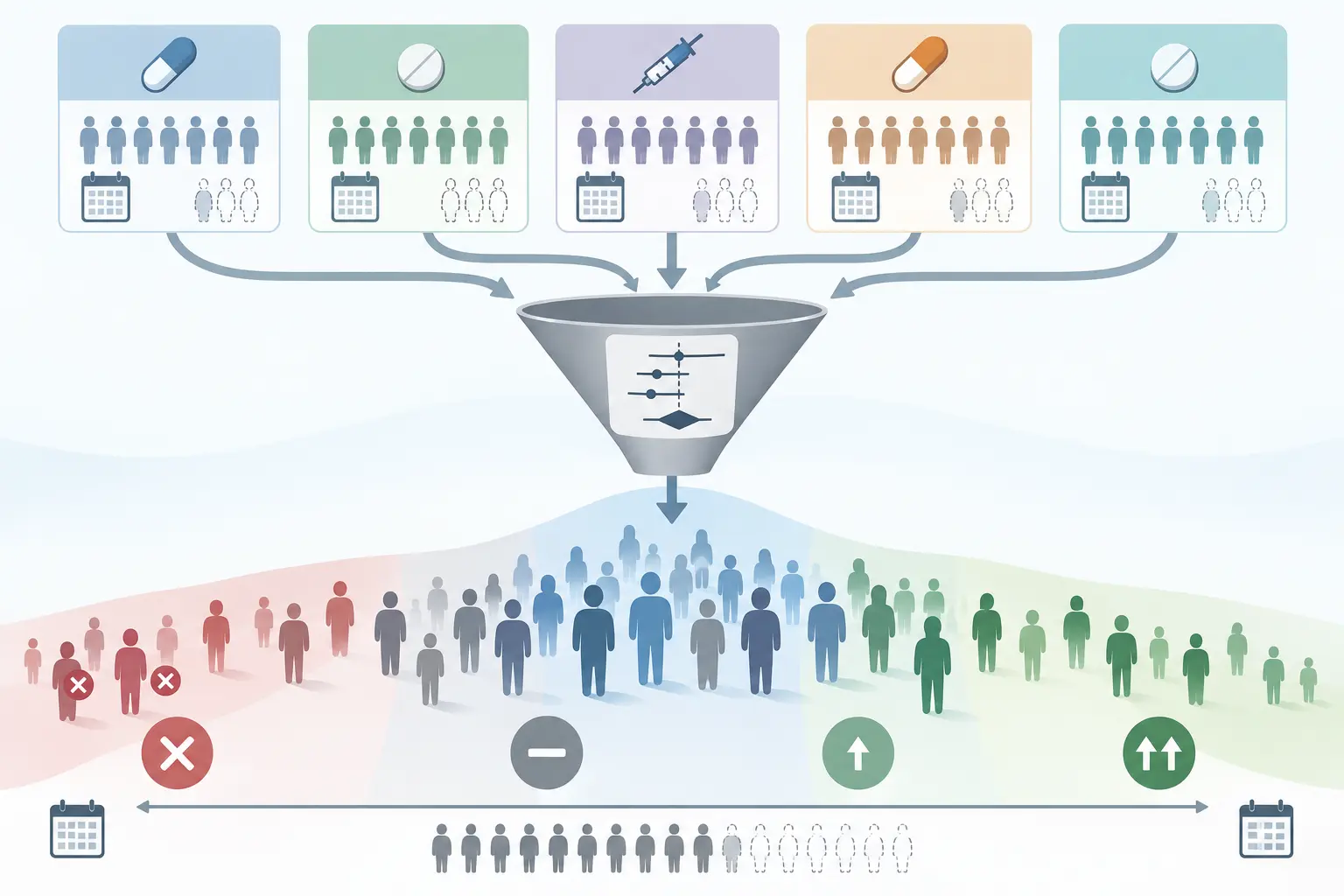
An average is not an individual forecast
Even a credible average includes people who lost more, lost less, changed little, gained weight, or stopped treatment. Baseline weight, adherence, food environment, sleep, medicines, health, and compensatory behavior shape outcomes. Advertising commonly highlights an outlier while omitting the comparison group and full distribution.
Do not convert a brief laboratory change into annual weight loss. Multiplying a few hours of measured thermogenesis across 365 days assumes the effect never adapts and never changes appetite or movement. That extrapolation is not a clinical result.
Use a minimum-worthwhile-effect decision
Before buying, define the smallest additional benefit that would justify the cost, inconvenience, uncertainty, and risk. Then ask whether product-level evidence makes that benefit plausible. If exact ingredient amounts are missing, the effect cannot be matched confidently to trials.
Use a two-week baseline for weight averages, waist, hunger, sleep, blood pressure when appropriate, caffeine, food pattern, and movement. If testing a supplement, keep other variables stable and set a review date. Stop for adverse effects. A trend after purchase still cannot isolate causation, but it can show whether the entire routine remains tolerable and useful.
Where Fat Burn Active fits
No defensible amount of weight loss can be promised from Fat Burn Active without suitable finished-product trials. Its available label information can support a safety and plausibility review, not a guaranteed forecast.
Fat Burn Active is optional and is not required for fat loss. Its label and finished-product evidence must answer the claim; research on a different medicine or isolated ingredient cannot do that work. Feeling warmer, more alert, less hungry, or seeing a short-term scale change does not prove meaningful fat loss.
The official Fat Burn Active page lists a multi-ingredient thermogenic formula, but the buying decision should follow the evidence check above. Compare our independent review, then, if the product remains a reasonable fit, check the current price and label on the official site. We may receive a commission at no additional cost.
Frequently asked questions
How many pounds will a fat burner add to my loss?
No universal number is evidence-based. It depends on the exact product and the difference versus a comparable control.
Does feeling more energy predict more weight loss?
No. Alertness is not a validated substitute for long-term body-weight or fat-mass outcomes.
Are prescription obesity medicines included?
No. They have distinct mechanisms, regulation, evidence, indications, and medical supervision.
Sources
- NIH ODS: Dietary Supplements for Weight Loss
- Systematic review of dietary supplements and alternative therapies for weight loss
- FDA: Tainted Weight Loss Products
- NIDDK: Choosing a Safe and Successful Weight-loss Program
Sources reviewed September 13, 2026. This article is general educational information, not medical advice, diagnosis, or treatment.