Four evidence levels that must not be merged
Each level answers a different question. A label proves what is claimed to be present, not what a person will experience. An ingredient trial may show an average effect under controlled conditions, not the outcome of a different multi-ingredient product.
Dose matching is necessary but not sufficient
The official table makes useful calculations possible: 25 mg forskolin, 100 mg EGCG, about 44 mg guarana caffeine, 1.12 mg phenylcapsaicin, 6 mg synephrine, 10 mg 6-paradol, and 1.9 mg piperine. These calculated constituent amounts can be compared with research, but matching one number does not match the whole intervention.
Researchers may use another extract, population, calorie prescription, exercise program, duration, or outcome. A statistically detectable change in resting energy expenditure over several hours is not equivalent to meaningful fat loss over months. The comparison group, dropout rate, adverse events, and absolute effect also matter.
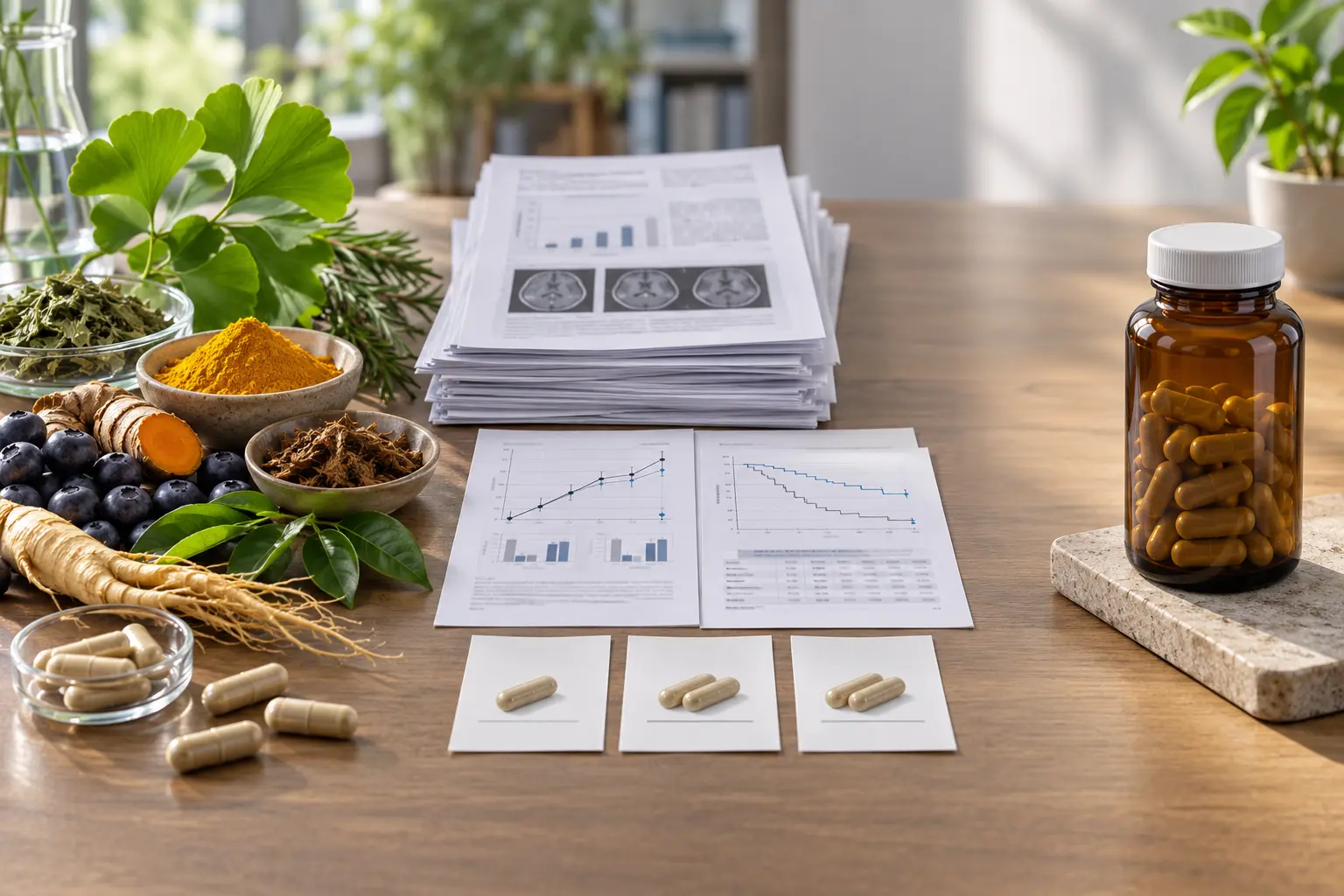
Why the complete formula can behave differently
Ingredients may overlap, interact, compete for absorption, affect tolerability, or change adherence. Caffeine can increase alertness while worsening sleep. Piperine may alter exposure to other compounds or medicines. A combination may add side effects without adding meaningful benefit, or one ingredient may dominate the experience.
It is therefore invalid to list eleven studies and add their favorable outcomes. The correct conclusion is narrower: the formula contains ingredients with varying levels of relevant evidence, but the finished product requires its own trial to quantify net benefit and harm.
What a useful finished-product trial would include
- The exact current formula and two-capsule serving.
- Random allocation and a credible placebo or active comparison.
- Enough participants and duration for meaningful weight or body-composition outcomes.
- The same nutrition and activity support between groups.
- Prespecified weight, fat mass, waist, adherence, and safety outcomes.
- Transparent attrition, adverse events, funding, registration, and analysis.
- Absolute between-group results with uncertainty, not only within-group change.
Until such evidence is available, ingredient research can inform but not complete the product verdict.
Worked example: one ingredient study, one unsupported leap
Suppose a study reports an acute energy-expenditure change after a standardized botanical. Fat Burn Active contains a related standardized extract. This supports a mechanism question if the dose and material are comparable. It does not prove that the product causes body-fat loss, because the product contains other ingredients and the study did not measure the product or a durable outcome.
An honest summary states the ingredient result, the match or mismatch, and the evidence distance. The sales claim stays unconfirmed until the finished formula is tested appropriately.
Make the unresolved questions visible

Before you order
If the current bottle matches the verified formula, the warnings and stimulant exposure fit your situation, and you accept the evidence limits, confirm current availability, price, delivery, and return terms on the official website. We may receive a commission at no additional cost to you. Results are not guaranteed.
Frequently asked questions
Do studied ingredients prove Fat Burn Active works?
No. They may support plausibility, but only a suitable trial of the exact formula directly tests the product.
Does dose disclosure solve the evidence problem?
It improves comparison with research but does not create finished-product results.
Can ingredient effects be added together?
Not reliably without testing the combination.
Was an exact-product trial identified?
We did not identify an independent controlled trial of the current marketed formula.
Sources
- Fat Burn Active official formula
- NIH ODS: Weight-Loss Supplements
- FDA: Questions and Answers on Dietary Supplements
- FTC Health Products Compliance Guidance
- NCCIH: Green Tea
Sources reviewed September 16, 2026. This article is general educational information, not medical advice, diagnosis, or treatment.