
What happens after a meal
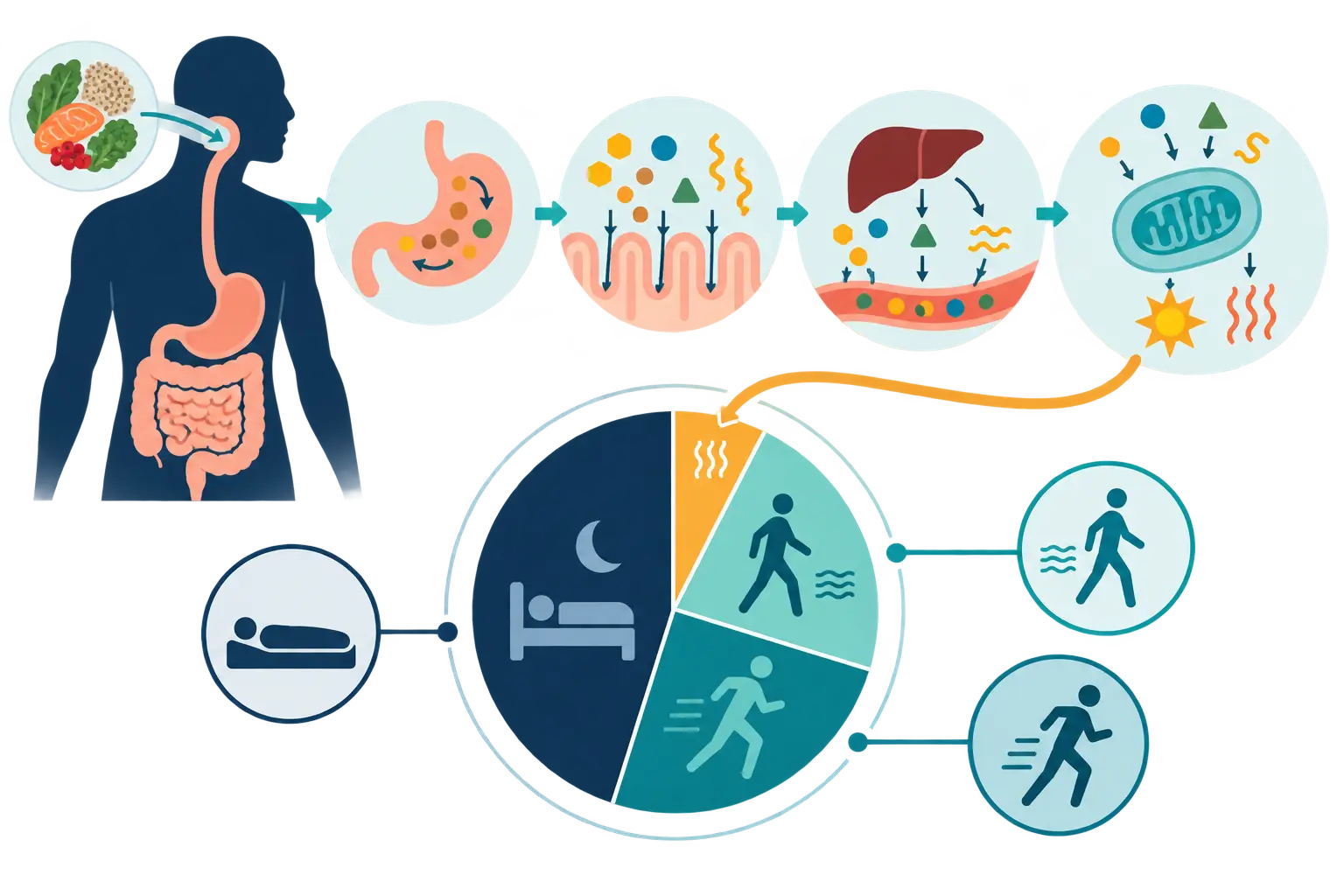
Resting metabolism does not stay perfectly flat after food arrives. Chewing, gastrointestinal movement, enzyme production, absorption, circulation, nutrient conversion, protein synthesis, and storage all require energy. Researchers call the rise above the pre-meal baseline diet-induced thermogenesis or the thermic effect of food.
The response begins after eating and unfolds over several hours. A larger meal usually produces a larger absolute response because more nutrient must be processed. That does not make overeating metabolically free: the extra processing cost is only a fraction of the energy consumed.
Where TEF sits in the daily energy budget
Maintenance calories reflect the combined total across time. TEF is already part of a well-constructed maintenance estimate; it should not be subtracted again from a food log.
How researchers measure it
Indirect calorimetry estimates expenditure from oxygen consumption and carbon-dioxide production before and after a standardized meal. Test duration matters because a short session can miss part of the response. Meal size, previous food, posture, room temperature, activity, and fat-free mass can influence results.
A wearable cannot isolate TEF from ordinary metabolism. Food apps that display “net calories” may invite false precision if they treat a population percentage as a personal measurement.
What changes the response
Meal energy and composition are major determinants. Protein has a higher proportional processing cost than carbohydrate, while dietary fat is generally lowest. Mixed meals create a blended response. Age, body composition, insulin sensitivity, activity, habitual diet, and study conditions may influence the result, but not every proposed factor is consistent across studies.
Alcohol can have a substantial thermic response, but that is not a reason to use alcohol for weight control. Its calories, health risks, and effects on sleep, food choices, and judgment overwhelm such a simplistic calculation.
Three mistakes that inflate TEF
- Counting gross instead of net energy. Food still supplies far more energy than processing normally costs.
- Adding TEF twice. Maintenance estimates already represent typical food processing.
- Equating protein with unlimited advantage. Total calories, nutrition, tolerability, and adherence remain decisive.
Worked example: why the percentage needs context
Imagine two mixed meals that each contain 600 calories. Their TEF will not be identical if one contains more protein, but neither has a fixed personal value printed on it. If an illustrative blended response were 10 percent, processing would use about 60 calories—not permission to record the meal as 540 with laboratory certainty.
The useful interpretation is qualitative: a balanced protein-containing meal may support fullness and has a higher processing cost than a predominantly fatty meal. The food log should still record the full intake consistently. A larger meal can create more thermogenesis in absolute calories while still delivering more net energy.
Turn the mechanism into a useful decision
When comparing meals, keep the denominator visible. A larger meal can create more thermogenesis in absolute calories while still delivering more net energy. A higher percentage does not tell you whether the meal supports protein, fiber, micronutrients, culture, budget, or medical needs. TEF is best used to understand the energy system, not to rank every plate. If a proposed change makes meals less satisfying and triggers later grazing, the theoretical gain can disappear inside the day's actual behavior. Judge the complete pattern.
Where a supplement fits
No fat burner substantially increases the thermic effect of food. Choosing more protein and less processed food has a modest, real effect.
Once the practical steps in this guide are working, decide whether an optional supplement adds enough value. Start with the Fat Burn Active review; if the formula and limitations are acceptable, see the current price on the official site. We may receive a commission.
Frequently asked questions
What is the thermic effect of food?
The energy used to digest, absorb and process food, roughly 10% of daily energy use.
Do some foods have negative calories?
No. Even celery provides more energy than it costs to digest.
Can I increase my thermic effect?
Eating more protein and less processed food can raise it slightly.
Sources
- National Academies: Factors Affecting Energy Expenditure
- Diet-Induced Thermogenesis Review
- The Thermic Effect of Food: A Review
- Measuring the Thermic Effect of Food
Sources reviewed September 14, 2026. This article is general educational information, not medical advice, diagnosis, or treatment.