
Compare route, not marketing strength
Glucomannan is not simply a quiet fat burner
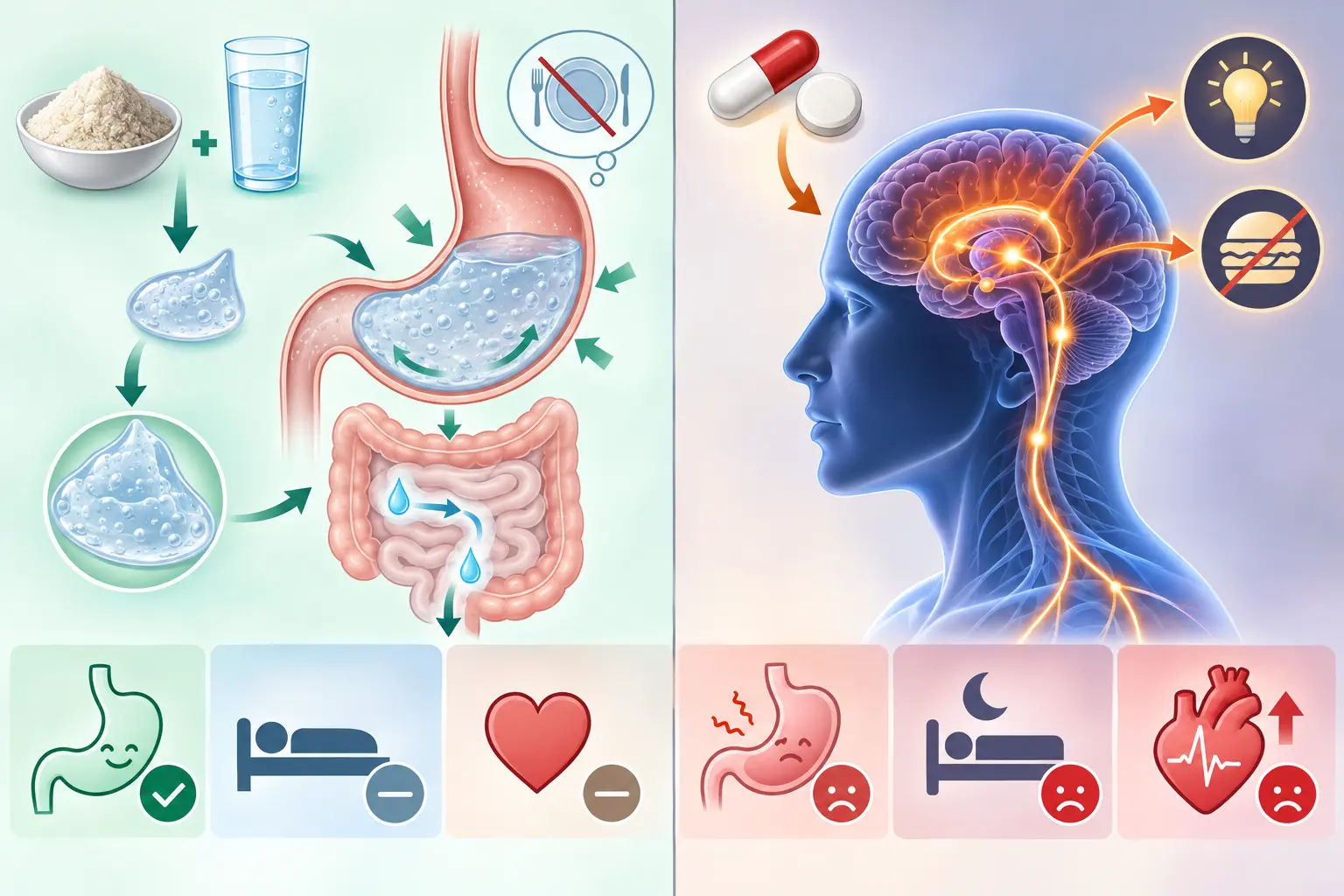
Its proposed advantage comes from viscosity and volume rather than thermogenesis. Trials differ in dose, meal timing, dietary support, duration, and adherence. Regulatory claim conditions in one jurisdiction should not be generalized to every label or person.
The powder must reach the stomach with enough liquid. Products require careful directions because inadequate fluid or swallowing difficulty can create obstruction risk. Fiber may also affect medicine absorption or timing, so pharmacists can help separate doses appropriately.
Appetite change can be real and still unhelpful
A stimulant can delay hunger, make skipped meals easier, or mask fatigue. That does not guarantee lower weekly intake. Rebound hunger, late eating, poor sleep, anxiety, tolerance, or reduced recovery may erase the short-term advantage.
Record appetite before meals, actual intake, sleep, pulse symptoms, timing, and next-day hunger. If a product merely makes hunger easier to ignore during an overly aggressive deficit, the safer solution may be a more adequate meal plan.
Match the tool to the actual bottleneck
For low-fiber meals, ordinary foods—beans, oats, vegetables, fruit, whole grains, nuts, and seeds—add nutrients and eating structure. Glucomannan may offer convenience when a qualified professional agrees it fits. For fatigue-driven eating, investigate sleep, meal adequacy, schedule, medicines, and health rather than automatically adding stimulation.
A person with swallowing or gastrointestinal disorders may be a poor fiber candidate. A person with cardiovascular disease, hypertension, palpitations, anxiety, pregnancy, or relevant medicines may be a poor stimulant candidate. When both sets of concerns apply, the comparison should stop.
Worked comparison: the same goal, different failure modes
Person A becomes hungry because lunch contains little protein, fiber, or total food. A water-absorbing fiber may change fullness, but rebuilding lunch addresses the cause more directly. Person B skips lunch after a stimulant, then eats heavily at night when the effect fades. Stronger appetite suppression may intensify the pattern rather than solve it.
Person C has an adequate meal pattern but wants a modest convenience tool. Glucomannan might be considered only with appropriate water, swallowing ability, gastrointestinal tolerance, and medicine timing. A stimulant might be considered only after total exposure, cardiovascular context, anxiety, sleep, and tolerance are reviewed. These are three different decisions, not a universal product ranking.
Use an appetite-and-intake timeline
- Rate hunger before meals without trying to suppress it.
- Record meal composition, timing, and whether the meal was finished.
- Note cravings, energy, sleep, stress, and gastrointestinal symptoms.
- For stimulants, record dose time, caffeine total, pulse symptoms, and bedtime.
- For glucomannan, record fluid, product form, meal timing, and medicine separation.
- Review seven-day intake patterns rather than one low-hunger afternoon.
The useful outcome is not the smallest hunger rating. Hunger supports adequate nourishment. The question is whether the chosen approach makes an appropriate plan easier without creating a later problem.
Red flags that remove both options
Difficulty swallowing, unexplained abdominal symptoms, recurrent vomiting, a history of obstruction, uncontrolled cardiovascular symptoms, severe anxiety, pregnancy, or an eating-disorder pattern calls for professional assessment instead of self-directed appetite suppression. A label cannot diagnose why appetite, fatigue, or weight has changed.
Seek urgent care for choking, inability to swallow, severe chest or abdominal pain, fainting, breathing difficulty, serious allergic symptoms, or a sustained irregular heartbeat. These are not expected signs of a successful product response.
Where Fat Burn Active fits
Fat Burn Active is a stimulant-containing thermogenic formula, not a glucomannan product. It may affect alertness or appetite sensations, but it should not replace fiber-rich meals or be treated as equivalent to a viscous-fiber intervention.
Fat Burn Active is optional; no supplement is required for fat loss. Its current formula must be judged as a combination, not as the winner of any isolated-ingredient comparison. Read our independent Fat Burn Active review, verify the current label and all-source caffeine, and compare the product with the option of using neither.
Fat Burn Active is relevant here because its official listing identifies standardized plant extracts, caffeine sources, vitamins, and zinc in one formula. First read our independent review. If the formula, stimulant profile, evidence limits, and warnings fit your situation, check the current Fat Burn Active price on the official website. We may receive a commission at no additional cost.
Frequently asked questions
Is glucomannan a stimulant?
No. It is a water-absorbing dietary fiber derived from konjac.
Which suppresses appetite more?
There is no universal head-to-head answer; preparation, dose, person, and outcome differ.
Can I combine fiber and a stimulant?
Do not assume compatibility; review water, medicine timing, total ingredients, and personal risks.
Sources
- NIH ODS: Weight-Loss Supplements
- Glucomannan randomized controlled trial
- EFSA: Glucomannan and weight-loss claim
- FDA: How Much Caffeine Is Too Much?
Sources reviewed September 14, 2026. This article is general educational information, not medical advice, diagnosis, or treatment.