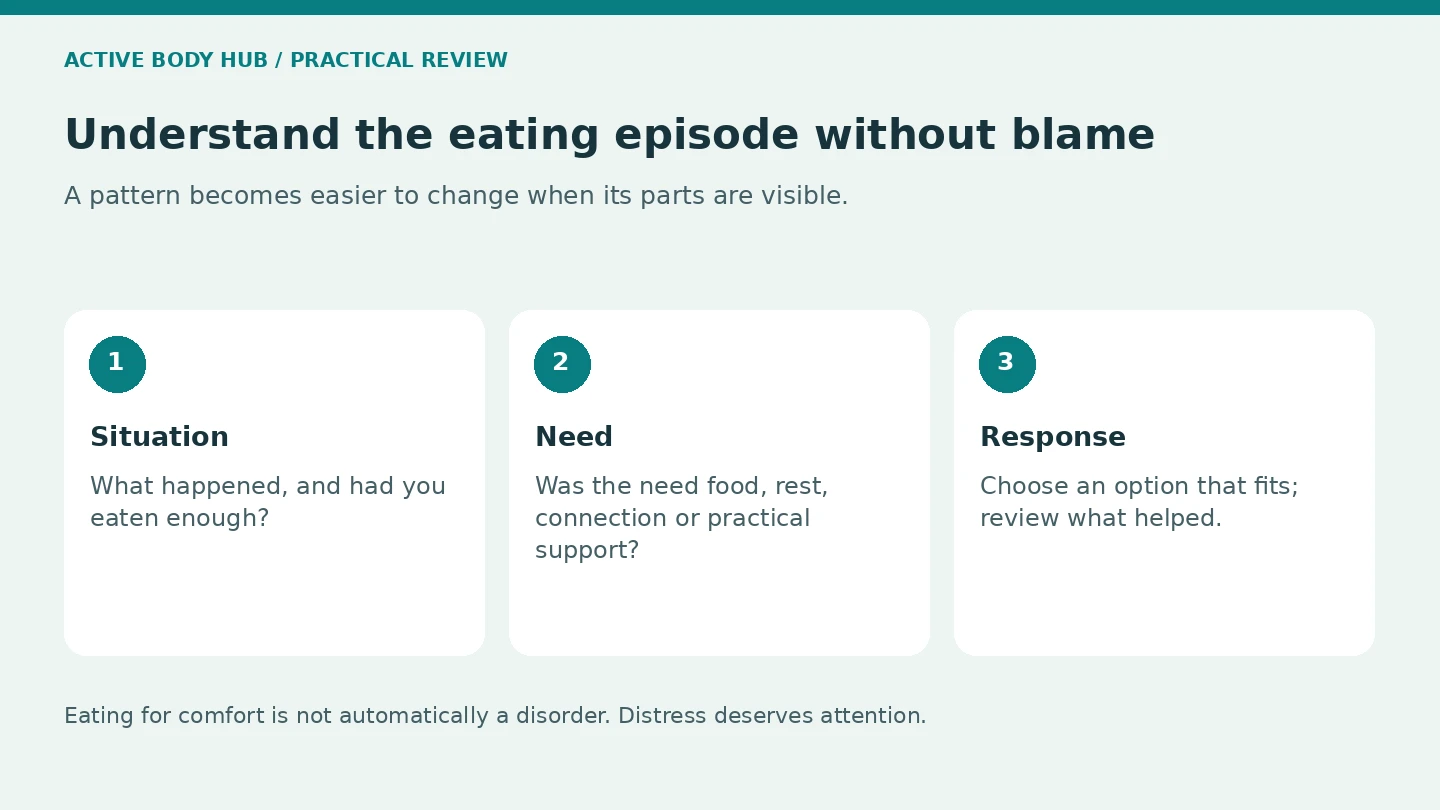
Why shame keeps the cycle alive
Emotional eating is often described as a failure of control. That framing misses its function. Food can provide pleasure, distraction, comfort, ritual, connection, and temporary relief. The problem develops when it becomes the only available response, produces distress or loss of control, or repeatedly conflicts with health and life goals.
Shame adds another difficult emotion, which can create another reason to eat. Compensating by skipping meals increases physical hunger, making the next episode more likely and harder to understand. A useful plan separates the trigger, the behavior, the short-term benefit, and the longer-term cost without moral language.
Physical hunger and emotional eating side by side
These clues are tendencies, not a test. Emotional eating can be slow and deliberate. Physical hunger can feel urgent after long restriction. Mixed episodes are common.
Map the complete trigger chain
Look beyond the emotion label. “Stress” may include a missed lunch, an argument, visible snacks, a delivery notification, exhaustion, and a learned evening routine. The more precisely you map the sequence, the more places you can intervene.
- Vulnerability: poor sleep, restriction, pain, alcohol, isolation, or an unusually demanding day.
- Prompt: a message, conflict, deadline, memory, celebration, boredom, or arriving home.
- Thought: “I deserve this,” “today is ruined,” or “food is the only thing that will help.”
- Action: ordering, grazing, eating secretly, or continuing past comfort.
- Consequence: short relief, discomfort, guilt, more restriction, or avoidance.
Change the earliest practical link. Preparing lunch may work better than fighting the urge at 10 p.m. [1]
Choose an option that matches the need
| What you notice | A possible need | An option to try |
|---|---|---|
| You missed lunch and feel overwhelmed | Food and practical relief | Eat adequately, then simplify the next task. |
| You feel lonely after work | Connection | Contact someone you trust or arrange a shared activity. |
| A deadline keeps following you home | A boundary or practical plan | Write the next task and a realistic stopping point. |
| You want to celebrate | Enjoyment and connection | Choose food or another activity deliberately, without compensation. |
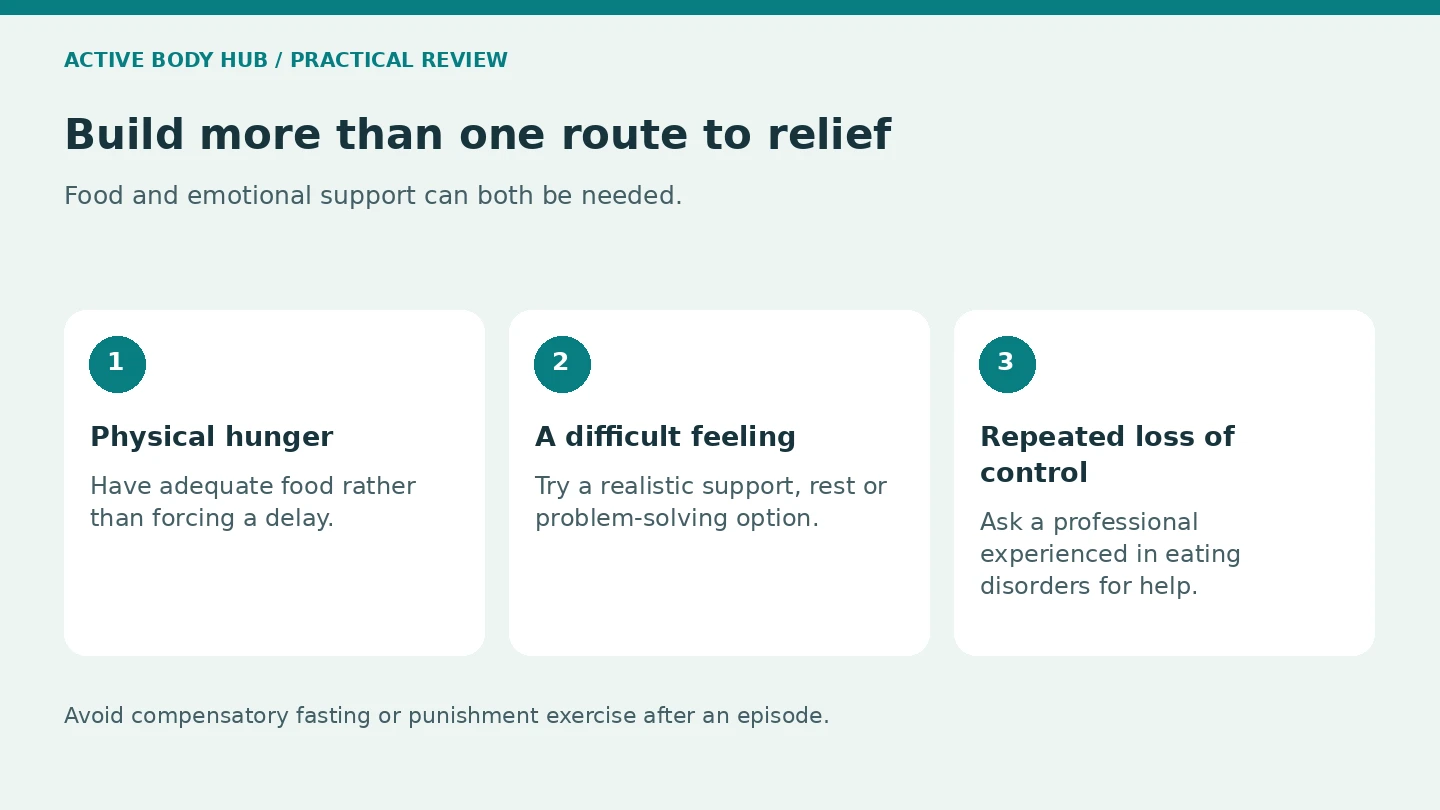
These are possibilities, not a test that identifies your emotion. Choose something available in real life. A two-minute option may be more useful than an elaborate routine you cannot use at work. If you are physically hungry, coping skills do not replace a meal.
Redesign the high-risk environment
Reduce friction for the response you want. Keep planned meals available, portion snack foods instead of eating from large packages, remove delivery-app prompts, and create an end-of-work transition that does not begin in the kitchen. If an item repeatedly triggers loss of control, change how and where it is bought without declaring it morally forbidden.
Social situations need a plan too. Decide how to eat before an event, include foods you enjoy, and avoid arriving extremely hungry. Afterward, return to normal meals. A single social meal does not require punishment.
If privacy fuels the pattern, eat seated and plated when practical. Visibility is not surveillance; it turns an automatic sequence into an observable choice. [5]
A simple note for a difficult evening
Write four lines: what happened before eating; whether meals had been adequate; what you hoped food would change; and what remained afterward. Leave out calorie totals if they add distress. The purpose is to find a useful intervention point, not grade yourself.
For example, an evening episode may follow both a missed lunch and an upsetting call. Arranging lunch addresses one part; planning support after the call addresses another. This is an illustrative scenario, not a patient story or a promised result.
For more on overlapping urges, read food and sugar cravings. If under-eating is part of the cycle, use the diet-hunger guide.
Review an episode without punishment
Wait until the urgency settles, then reconstruct the episode in neutral terms. What had you eaten? What happened emotionally? What cue started the sequence? At what point was another option still realistic? What did the food provide for ten minutes, and what remained afterward?
Choose one change for next time: a larger lunch, a call after a difficult meeting, removing an app notification, buying a single portion, or asking for professional help. Progress can mean earlier awareness, a smaller amount, less secrecy, a shorter episode, or no compensation afterward. It does not require instant elimination.
When supported care is the better next step
Seek help when episodes are frequent or distressing, feel out of control, involve secrecy, or lead to fasting, purging or punishment exercise. A large meal alone does not diagnose binge-eating disorder. A professional experienced in eating disorders can assess the pattern. [3]
A 2023 systematic review of 34 studies found that emotional-eating interventions showed promise, with small average weight changes and substantial variation between studies. That supports addressing the eating pattern, not promising that one coping technique will produce weight loss. [2]
Treatment may include psychotherapy, nutritional support and care for coexisting conditions. If binge eating is present, discuss whether it should be addressed before or alongside weight management. Do not assume a more restrictive diet is the appropriate first step. [3]
Make the next conversation easier
You do not need to wait until the situation is severe. Bring a brief description of when episodes happen, whether you feel in control, any compensation afterward, and how eating affects your daily life. Eating disorders are serious, treatable conditions; body size alone cannot tell you whether support is needed. [4]
Where Fat Burn Active does not fit
A fat burner is not a treatment for emotional eating or an eating disorder. It cannot supply emotional support, make up for missed meals or resolve repeated loss of control. Appetite suppression is not a substitute for understanding the pattern.
If you separately want to assess the supplement, read our formula and evidence review, which contains affiliate links. We may earn a commission if you buy. The commercial relationship does not make the product an answer to emotional eating.
Frequently asked questions
Is emotional eating always unhealthy?
No. Food can be part of comfort and celebration. Concern rises when it is frequent, distressing, compulsive, or the only coping method.
Can emotional eating happen when physically hungry?
Yes. Under-eating can combine with stress or cues, so both adequate food and emotional support may be needed.
Should I compensate the next day?
No. Return to regular meals. Restriction can increase hunger and reinforce the cycle.
Sources and editorial notes
- American Diabetes Association: Emotions and Eating
- Systematic Review: Emotional Eating Interventions (2023)
- NIDDK: Diagnosis and Treatment of Binge Eating Disorder
- NIMH: Eating Disorders
- Mayo Clinic: Emotional Eating
Sources reviewed October 25–26, 2026. Prepared with AI assistance to organize evidence and practical planning examples. No clinical review, personal product use or laboratory testing is claimed. This is educational information for adults, not an individual treatment plan.