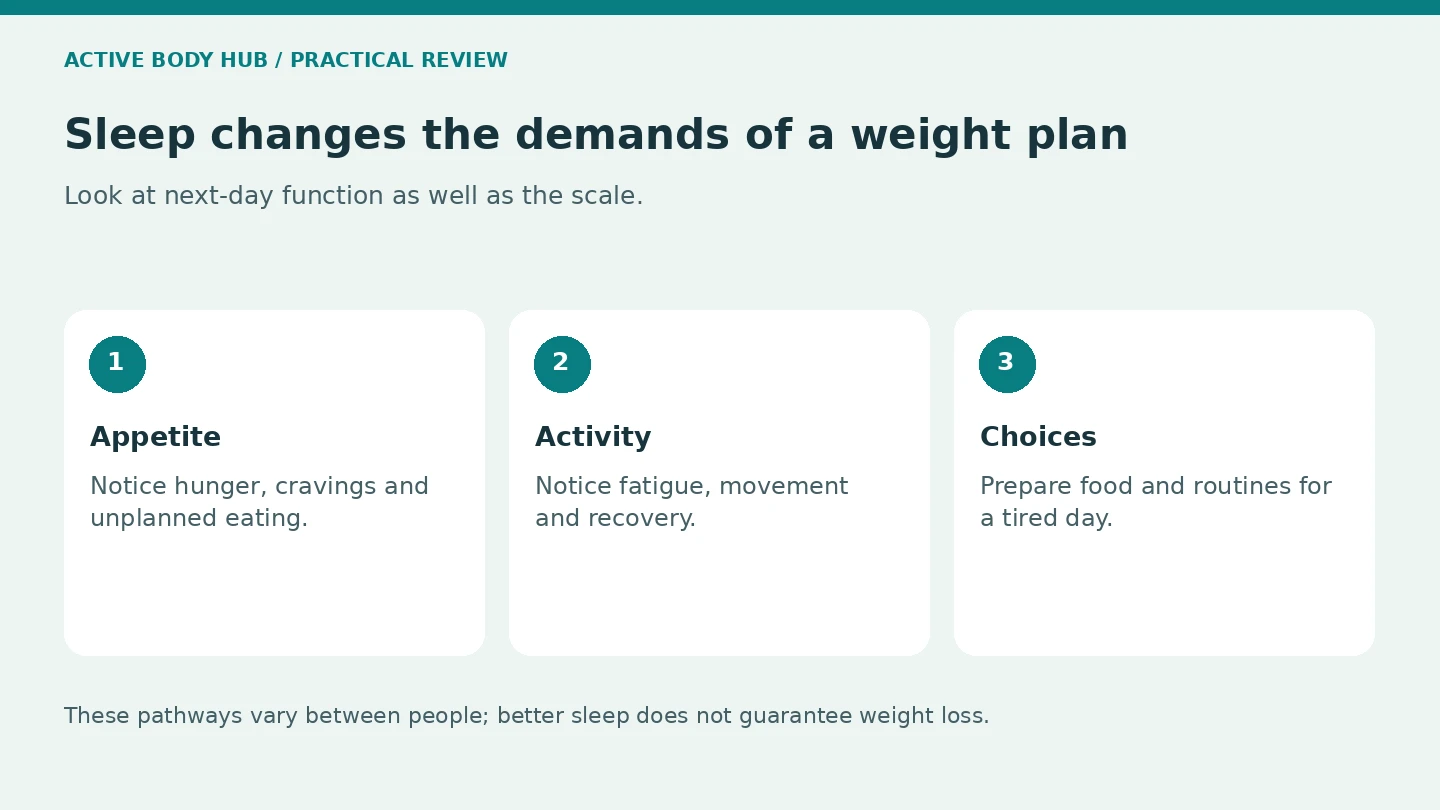
The deficit may look unchanged while the person changes
A meal plan can remain identical on paper while sleep loss changes how it is executed. A tired person may pour larger portions, snack while seeking alertness, order convenient food, skip a walk, or reduce training output. Staying awake longer also creates more opportunity to eat.
These effects are not proof of weak discipline. Sleep supports attention, impulse control, emotional regulation, and physical recovery. When it deteriorates, the plan asks more effort at the same time the person has fewer resources to provide it.
Energy balance still applies. Poor sleep can influence both intake and expenditure rather than creating fat independently of calories.
Five pathways from a bad night to a harder diet
No single pathway operates identically in everyone. That is why the useful target is the observed pattern, not a universal hormonal explanation.
What the clinical studies actually show
In a 2022 randomized trial, 80 adults aged 21–40 with overweight and habitual sleep below 6.5 hours received either sleep-extension counseling or continued their usual sleep. Energy intake decreased on average in the sleep-extension group. The intervention was short and the population specific; this was not proof that every person will eat less or lose weight by going to bed earlier. [2]
A separate crossover study involved ten adults during two 14-day dieting periods with different sleep opportunities. Shorter sleep altered the proportions of fat and fat-free mass lost. Its small sample and laboratory setting limit generalization. Neither trial tested a fat burner or established a long-term weight-loss guarantee. [3]
Find the sleep bottleneck before choosing a fix
| What you notice | First question | Useful direction |
|---|---|---|
| Too little time available | Is work, caregiving or a habit compressing sleep? | Protect an achievable sleep window and simplify the next day. |
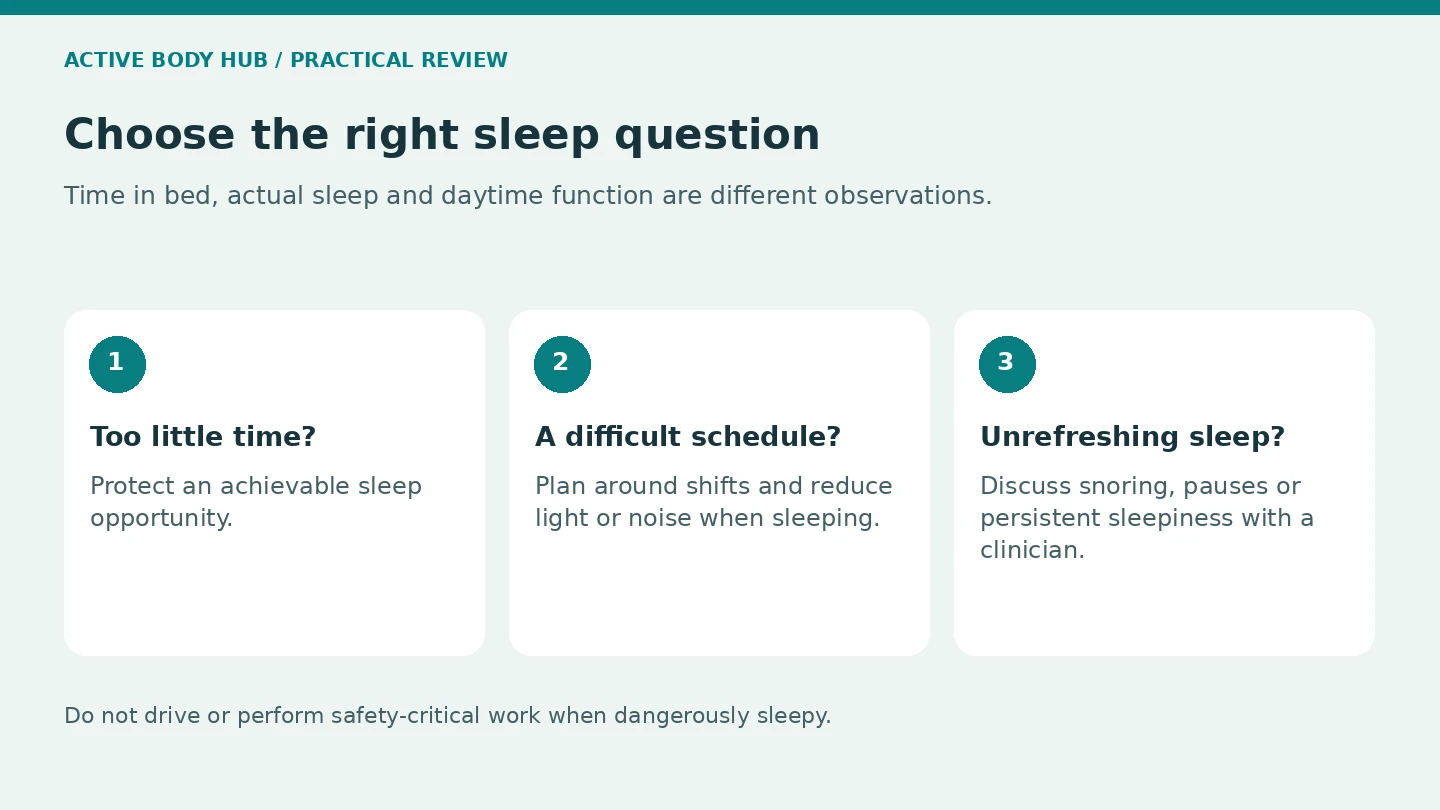
| A changing work schedule | When can you reliably sleep? | Plan sleep opportunity and reduce light or noise during daytime sleep. |
| Enough time but unrefreshing sleep | Are there breathing pauses, snoring or repeated awakenings? | Discuss symptoms with a clinician rather than just extending time in bed. |
| Late caffeine to overcome fatigue | Is it interfering with the next sleep period? | Review timing and all caffeine sources. |
CDC recommends at least seven hours for adults aged 18–60, with different ranges for older adults. Quality matters too: repeatedly waking or staying sleepy despite enough time deserves attention. This is general guidance, not a requirement to force a fixed number of hours. [1]
Interpret a plateau without blaming one night
One short night may affect appetite, but it cannot explain every plateau. Compare repeated patterns: are the hardest food days consistently preceded by short or fragmented sleep? Did steps fall during a stressful month? Did caffeine move later as fatigue grew?
If sleep improves but weight does not change, the intervention may still have improved safety, mood, or adherence. Review portions, drinks, weekends, medicines, and movement before declaring sleep irrelevant. If weight changes rapidly alongside severe sleep symptoms, obtain medical assessment.
A modest deficit that protects sleep can outperform a larger target that produces fatigue, cravings, and repeated rebound eating.
A decision rule that avoids false conclusions
Use four outcomes together: sleep opportunity, next-day hunger, completed movement, and the weekly weight average. If sleep improves and hunger falls but weight remains flat, check whether portions or movement changed before deciding the sleep work was useless. If weight falls while daytime sleepiness becomes dangerous, the plan is not a success.
A second trap is reverse causation. Weight gain can increase sleep-apnea risk, pain can disrupt sleep and activity, and a new medicine can affect all three. A timeline is more useful than a slogan: record when snoring, fatigue, weight change, schedule changes, and medicines began.
Finally, distinguish “I went to bed earlier” from “I slept longer and better.” Time in bed, actual sleep, continuity, and daytime function can move differently. That distinction determines whether to protect more time, improve the environment, or seek assessment.
Make the plan work on a difficult schedule
For a rotating shift, choose the sleep period you can protect and arrange food before the shift rather than leaving every choice to the most exhausted hours. Keep the sleeping space dark and quiet when possible. NHLBI suggests limiting caffeine to the first part of a shift and discussing persistent difficulty with a clinician. [4]
If caregiving repeatedly interrupts sleep, another strict bedtime rule may be unrealistic. Look for a shared task, prepared meal or safer activity plan that reduces the next day’s demands. These are planning examples, not treatments for a sleep disorder.
Use our sleep-first checklist or sleep and hunger diary for a more focused review.
When sleep problems need medical assessment
Seek professional assessment for loud habitual snoring, witnessed breathing pauses, gasping, morning headaches, severe daytime sleepiness, near-miss driving events, restless legs, insomnia lasting for months, or sleepiness despite adequate opportunity. Obstructive sleep apnea can coexist with higher body weight and is not fixed by a supplement.
Do not drive or perform safety-critical work when dangerously sleepy. Chest pain, fainting, severe breathing difficulty, confusion, or new neurological symptoms require urgent care. People who are pregnant, under 18, use sedating or stimulating medicines, or manage cardiovascular, psychiatric, endocrine, or sleep disorders need individualized advice. [5]
Why a fat burner is a poor answer to sleep loss
A stimulant may make you feel more alert while interfering with later sleep. It does not treat insomnia, sleep apnea or a difficult shift schedule. Fat Burn Active should not be used as a solution to those problems.
For supplement-specific questions, our product review explains the formula and evidence limits. It contains affiliate links; we may earn a commission if you buy. Consider sleep and safety before a purchase.
Frequently asked questions
Can I lose weight while sleeping poorly?
Yes, if a deficit is sustained, but poor sleep may make that deficit harder to execute and can affect appetite, movement, and recovery.
Will one bad night stop fat loss?
No. Look at repeated sleep and behavior patterns rather than one night or one weigh-in.
Should I exercise after little sleep?
Adjust intensity for safety and performance. Avoid risky training or driving when severely sleepy.
Sources and editorial notes
- CDC: Sleep Duration, Quality and Health
- Randomized Trial: Sleep Extension and Energy Intake (2022)
- Crossover Trial: Insufficient Sleep and Dietary Weight Loss (2010)
- NHLBI: Healthy Sleep Habits and Shift Work
- NHLBI: Sleep Apnea Symptoms
Sources reviewed October 25–26, 2026. Prepared with AI assistance to organize evidence and practical planning examples. No clinical review, personal product use or laboratory testing is claimed. This is educational information for adults, not an individual treatment plan.