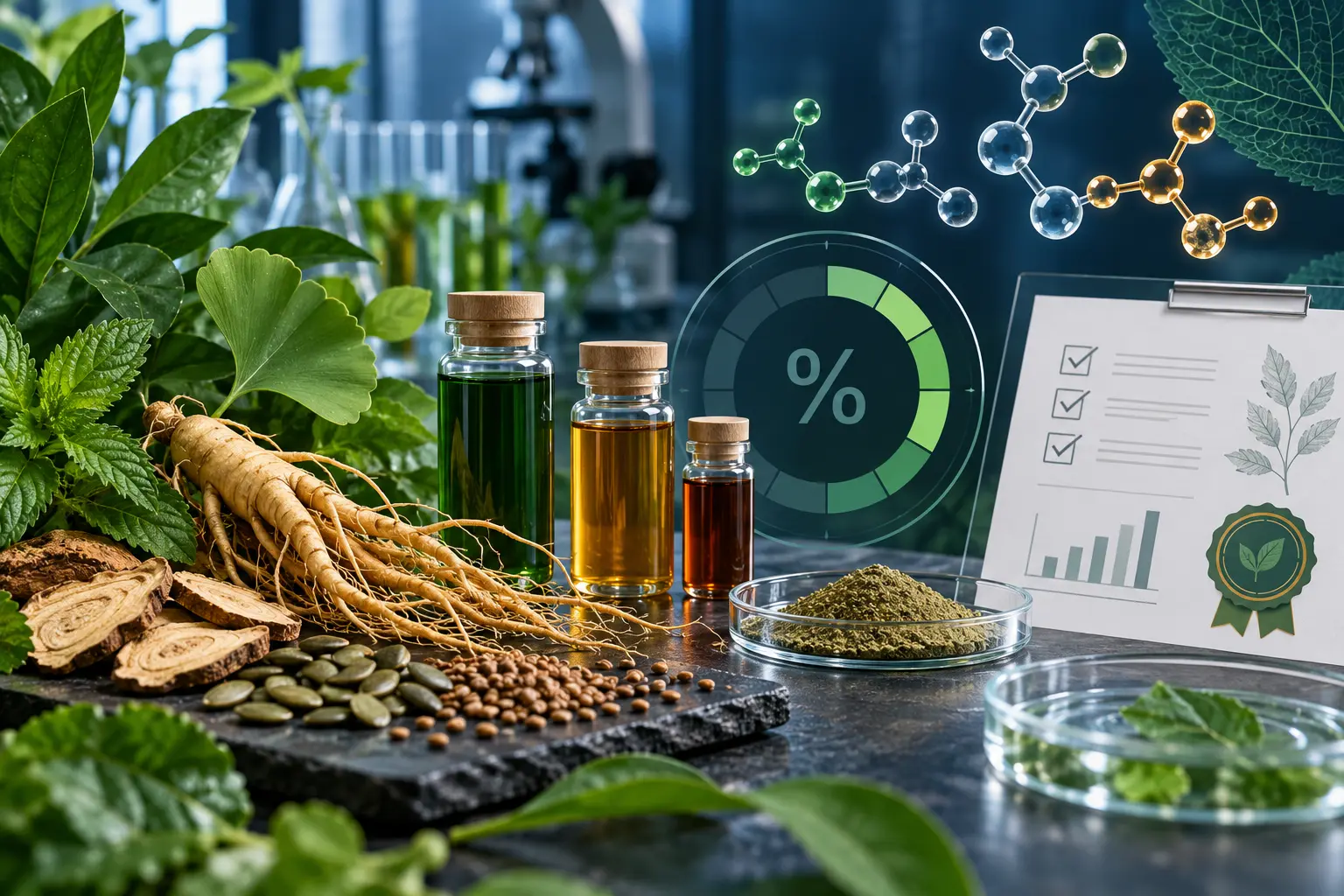
The six fields a useful botanical line needs
- Common name and Latin binomial to establish identity.
- Plant part, such as leaf, root, rind, seed, or fruit.
- Actual extract mass per serving.
- Named standardized constituent or marker.
- Percentage or milligrams of that constituent.
- Serving frequency and maximum daily use.
Extraction solvent, native extract content, carrier, fingerprint testing, and certificate of analysis can add quality context. A front label showing only a plant image and a large percentage is not enough.
Calculate the active-compound amount
Four hundred milligrams of green tea extract standardized to 40% EGCG supplies a calculated 160 mg of EGCG per serving. Two servings supply 320 mg. This calculation does not reveal caffeine unless caffeine is separately disclosed, and it does not prove that the formula produced a clinical outcome.
If only “40% EGCG” appears inside an undisclosed blend, the dose cannot be calculated because the extract mass is missing.
Marker compound is not always the proven active
Some extracts are standardized to a constituent believed to contribute to activity. Others use a marker mainly to support consistency or identity. A marker's stable percentage does not guarantee that every relevant compound, contaminant, or biological effect is constant.
Ask whether human research tested that exact preparation and whether the constituent was measured as an exposure or merely named. “Standardized” should never be expanded into “clinically proven.”
What standardization does not tell you
It does not by itself prove species authenticity, plant-part accuracy, solvent residues, pesticides, heavy metals, microbes, undeclared drugs, dissolution, stability, or finished-product efficacy. Those questions need appropriate testing and documentation.
NIH notes that determining botanical quality from a label is difficult. Prefer manufacturers that provide lot-linked testing, explain the method and specification, and avoid disease-treatment or guaranteed-result claims.
A worked example
A label reads: "Green tea leaf extract (Camellia sinensis), 500 mg, standardized to 45% EGCG." Multiply 500 mg by 0.45 to get 225 mg of EGCG per serving. If the label recommends two servings a day, that is 450 mg of EGCG daily, which you can then compare with doses used in studies and with safety advice.
How to check that a label is accurate
Independent certification programs, such as USP Verified or NSF Certified for Sport, test whether products contain what the label says and screen for some contaminants. A certificate of analysis from the manufacturer is helpful only if it is batch-specific and from an independent laboratory.
How this applies to Fat Burn Active
Fat Burn Active lists several standardized extracts. Each percentage becomes useful only when paired with the corresponding extract milligrams and current maximum daily serving.
Fat Burn Active is relevant here because its official listing identifies standardized plant extracts, caffeine sources, vitamins, and zinc in one formula. First read our independent review. If the formula, stimulant profile, evidence limits, and warnings fit your situation, check the current Fat Burn Active price on the official website. We may receive a commission at no additional cost.
Frequently asked questions
Does standardized mean clinically proven?
No. It describes a compositional specification, not a health outcome.
How do I convert a percentage to milligrams?
Multiply extract milligrams by the decimal percentage—for example, 400 mg × 0.40 = 160 mg.
Is the marker always the active ingredient?
No. Some markers support consistency or identity without being the sole proven active.
Sources
- NIH ODS: Botanical Supplement Background
- FDA Dietary Supplement Labeling Guide
- NIH Dietary Supplement Label Database
- 21 CFR 101.36: Supplement Facts
Sources reviewed September 8, 2026. This article is general educational information, not medical advice, diagnosis, or treatment.